
9 mins read
Last updated : 10-08-2026
The Complete Life Cycle of an Organic Coconut
A coconut does not begin its journey when it reaches the kitchen. Its story starts in the soil, where water, organic matter, sunlight and careful farming support the coconut tree. In an integrated natural farming system, cows and goats can contribute manure to the soil, coconut trees produce tender and mature coconuts, mature kernels become copra, and copra can be mechanically processed into cold-pressed coconut oil. Suitable by-products can then return to the farm, creating a circular agricultural system.
What Is Organic Coconut Farming?
Coconut farming is made costly friendly with our cocnepts of natural farming, without depend on artifical fetilizers and helps fight against deadly diseases of whitle flies. Use natural manures from cows, goats, hens. prepare panchakavya, Meen amilam, Jeeamutha for the soil benefits.
At its heart, natural coconut farming is about maintaining a relationship between the soil, water, coconut trees, animals, farmers and food we consume.
The Natural Coconut Farming Cycle<
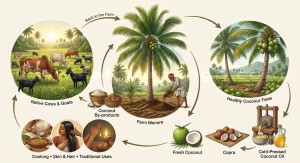
The coconut farming process can be understood as a continuous cycle rather than a single production step:
Healthy coconut production begins beneath the surface. Coconut palms require water, nutrients, sunlight and suitable soil conditions for good growth and production.
In an integrated farm, cows and goats may graze on suitable grasses and vegetation. Their manure can be collected, composted or appropriately managed before being returned to the soil.
Organic matter contributes to soil structure and nutrient cycling. As water moves through the soil, coconut roots absorb water and available nutrients required for plant growth.
The objective is simple: support the soil so the soil can support the coconut tree.
2. Cows and Goats: Part of the Natural Nutrient Cycle
Livestock can play an important role in integrated farming systems. Cows and goats consume suitable grasses and farm vegetation, while their manure can return organic matter and nutrients to agricultural soil when properly managed.
The cycle can therefore be represented as:
Grass and vegetation → Cows and Goats → Manure → Soil → Coconut Trees
This does not mean that every nutrient moves directly from an animal to a coconut. Instead, the farm creates a nutrient-recycling system in which organic matter and nutrients can continually return to the soil.
A coconut palm can remain productive for many years when it receives suitable water, nutrients and care.
Its roots explore the soil, its leaves capture sunlight and the tree produces flowers that eventually develop into coconuts.
The coconut develops inside a protective husk. As it matures, the kernel becomes thicker and richer in coconut fat, making the mature coconut suitable for food preparation and oil production.
The coconut is therefore not simply a fruit; it is the result of an entire farm ecosystem.
One of the remarkable features of the coconut is that different stages of its maturity can provide different products.
Young coconuts contain coconut water and soft coconut meat. Tender coconut water is commonly consumed fresh, especially in tropical regions.
As the coconut matures, its kernel becomes thicker and can be used in cooking, traditional food preparation and coconut-based products.
Mature coconut kernels can be dried under suitable conditions to produce copra. Copra has traditionally been an important raw material for coconut oil production.
Mature coconuts are harvested and opened to separate the kernel. The kernel is then dried using an appropriate drying method to reduce its moisture content.
The dried coconut kernel is known as copra. The quality of the copra is important because maturity, moisture, cleanliness and storage conditions can influence the quality of the oil produced from it.
Good-quality copra can be mechanically processed to extract coconut oil.
In cold-pressed processing, mechanical pressure is used to extract the oil without the high-temperature refining processes associated with refined coconut oil.
Depending on the raw material and processing method, cold-pressed coconut oil can retain the characteristic aroma and flavour associated with coconut.
The journey is therefore:
Mature Coconut → Coconut Kernel → Copra → Mechanical Pressing → Coconut Oil
The coconut journey does not necessarily end when the oil is extracted.
Coconut processing can produce useful by-products. Depending on the specific material, processing method and feed-safety requirements, suitable coconut meal or cake may be used as animal feed.
This creates another possible connection within an integrated farming system:
Coconut → Coconut Oil + Suitable By-Products → Animal Feed → Cows and Goats → Manure → Soil
By-products should only be used for animal feed when they are appropriate, safe and nutritionally suitable for the particular animal.
Modern agriculture can sometimes separate animal farming, crop production, processing and waste management into different activities. Integrated farming looks at how these activities can support one another.
Animals can contribute manure. Crops can provide suitable feed. Organic residues can sometimes be reused. Coconut trees provide food and raw materials, while coconut processing creates additional products and by-products.
When these relationships are carefully managed, the farm can reduce unnecessary waste and improve nutrient recycling.
This is one of the central ideas behind circular agriculture.
Responsible organic and natural farming involves more than simply avoiding a particular agricultural input.
A farm should only be described as certified organic when it meets the requirements of the relevant organic certification system.
Water alone does not create a productive coconut farm. Coconut palms require water, nutrients, sunlight and suitable soil conditions.
Organic matter can contribute to soil structure and nutrient cycling. Healthy soil can support root growth and help create a suitable environment for soil organisms.
The coconut palm uses water and available nutrients through its roots and sunlight through its leaves to grow, flower and produce coconuts.
The journey of a coconut is much longer than the moment it reaches a kitchen.
A coconut begins as a flower on the palm. It develops under tropical conditions while the farmer manages the tree, soil and water. Depending on its maturity, it can become tender coconut, mature coconut, copra or coconut oil.
The products reach consumers, while suitable processing by-products can potentially return to the agricultural cycle.
A coconut can connect the farm, farmer, animals, soil, processor and consumer in one continuous agricultural story.
The value of a coconut is not only the price of one coconut or one litre of coconut oil. Its value can also be understood through the complete farming system behind it.
A farmer manages the soil. The soil supports the tree. The tree produces coconuts. The coconut provides food and oil. Suitable by-products can be reused. Animals can contribute manure. Manure can return organic matter and nutrients to the farm.
This is the beauty of circular farming: resources are managed as part of a connected system rather than as isolated products.
From a tiny flower to a mature coconut.
From coconut to copra.
From copra to cold-pressed coconut oil.
From the kitchen back to the farm through responsible reuse.
From animals to manure.
From manure back to soil.
From soil back to the coconut tree.
Soil gives to the tree. The tree gives to us. The coconut gives food and oil. Useful residues can return to the farm. And the cycle continues.
Organic coconut farming follows organic production principles that focus on soil management, nutrient cycling and permitted agricultural inputs. Certified organic farms must meet the requirements of the applicable certification standard.
Cows and goats can contribute manure to integrated farming systems. When properly managed, manure can return organic matter and nutrients to agricultural soil.
A mature coconut is harvested, opened and the kernel is dried under suitable conditions. The resulting dried coconut kernel is called copra.
Suitable copra can be mechanically processed to extract coconut oil. Cold-pressed processing uses mechanical pressure without the high-temperature refining processes associated with refined coconut oil.
Coconut copra are cold pressed and after oil extract the coconut oil cake is very good feeds for cows to increase the milk natural acts as lactation feed.
Yes their certifed by famers self,In the world of heavy costs required to spend to just to take paper. Self certifications helps the farmers who are never using any chemicals in the farms.
Grow naturally.
Feed the soil.
Care for the animals.
Respect the water.
Harvest responsibly.
Use the coconut wisely.
Return what can safely return to the farm.
That is the story behind a coconut — not simply a fruit, but a journey from soil to tree, tree to coconut, coconut to food and oil, and back to the farm.
At SalemMango, we believe consumers should understand the journey behind farm products. Our farm-to-home approach focuses on connecting agricultural produce with customers while sharing the story of how the product is grown, harvested and processed.
Learn more about our coconut products and farm-sourced products through SalemMango.